
關於氣動噪音
一般來說,聽覺的感覺僅限於一個特定的頻率範圍,即16Hz到20000Hz之間。人類在3000Hz至4500Hz頻率範圍內的聽力敏感度增強
將聲音與人類聽覺能力聯繋起來非常重要。當工程師模擬和分析聲音時,記住這一點很重要,
強調最重要的頻率來表徵測量的聲音。其中包括響度(對聲壓主觀感知)以宋為單位和噪音加權(分貝)等概念。
模擬氣動聲學問題:湍流流場預測能夠準確地捕捉這些物理現象、高情度預測振幅和頻率
PUE值越低,代表機房空調冷卻時所耗的電力就會更少,理想值為10。)目前標準為1.3
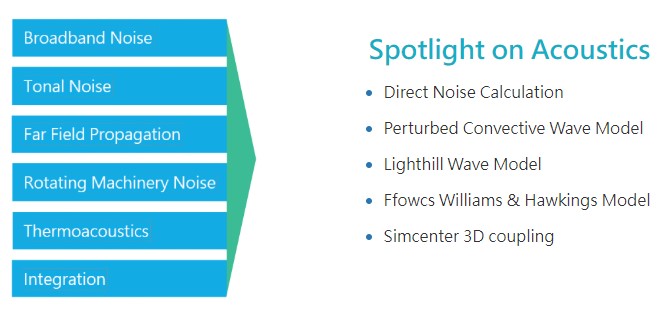
STAR CCM+應用於進行氣動聲學仿真
Lighthill Wave Model
Model Description
- The model uses a separate wave equation to solve for the Lighthill pressure (sum of acoustic and hydrodynamic pressures)
- Requires a scale-resolving simulation such as LES or DES
- Increased precision required at high frequency compared to Acoustic Wave model
Typical Applications
- Heat Ventilation and Air Conditioning (HVAC) duct noise
When to Use It?
- Incompressible flow applications
- Low Mach number flow (Ma <0.2)
STAR CCM+應用於進行氣動聲學仿真
HVAC管道噪音
Silent efficiency with hybrid aeroacoustics CFD: The Lighthill Wave model.It allows you to study noise in regions where the contribution of the turbulent fluctuations and the influence of convection is neglectable.Quite adequate for HVAC systems, where the human ear (receiver) is relatively far in the quiescent zone from the HVAC vents (noise source).
(1)Reduced time to results thanks to a less sensitive model.You can use coarser meshes; there is no spurious noise at mesh transitions. The pressure doesn' t need to be converged as accurately, leading to fewer inner iterations required per time step.
(2) Increased productivity with a simpler set-up; the Noise Source Weighting treatment, previously required for the Acoustic Wave solver, is not necessary any longer.
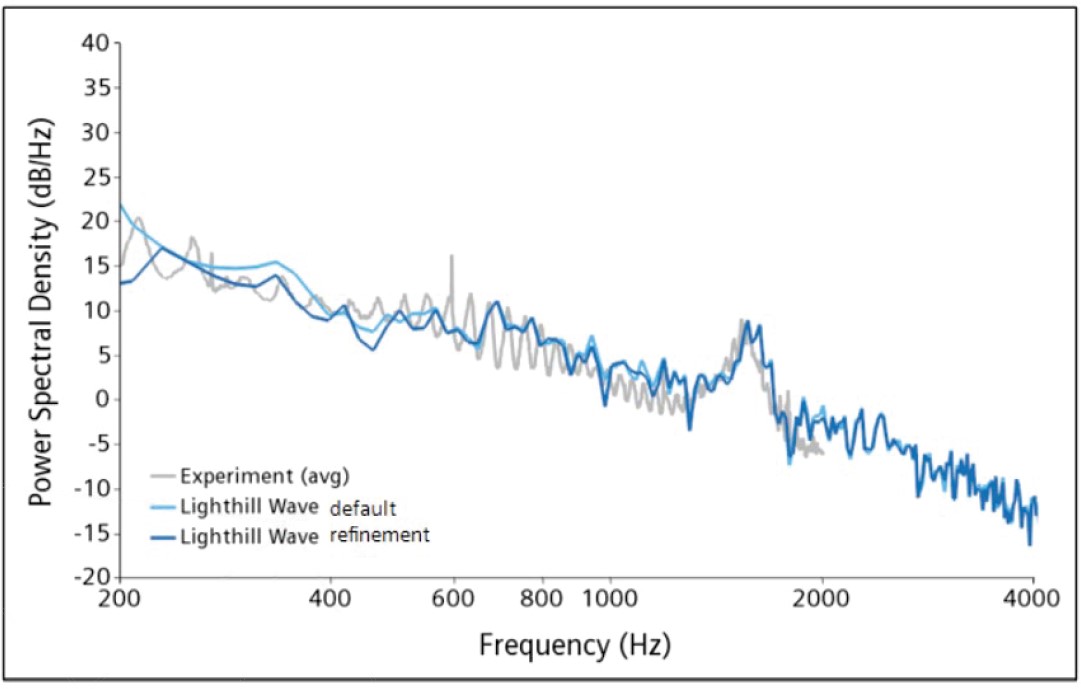
HVAC管道噪音電動車因行駛噪音小,艙內的空調的
.png)
STAR CCM+應用於進行氣動聲學仿真
Perturbed Convective Wave Model
Model Description
- Hybrid acoustic model which uses a wave equation to calculate sound generation and propagation
- Requires a scale-resolving simulation such as LES or DES to solve for an acoustic potential
- Allows coarser mesh and larger time-steps with improved high frequency accuracy (compared to Acoustic Wave model)
Typical Applications
- Rotating geometry cases
- Side mirror noise
- Fan noise
- Non-cavitating propellers
When to Use It?
- Incompressible flow
- applications
- Low Mach number flow
